

 русский
Content
- 1 What a Cable Pulling Winch Machine Does and Where It Is Used
- 2 Drive Mechanisms: Drum Winch vs. Capstan vs. Bullwheel Puller
- 3 Power Sources and Drive Systems
- 4 Key Technical Specifications to Evaluate
- 5 Cable Sidewall Pressure and Bend Radius Limits
- 6 Accessories and Supporting Equipment
- 7 Safety Standards and Operational Requirements
What a Cable Pulling Winch Machine Does and Where It Is Used
A cable pulling winch machine is a mechanical or electromechanical device designed to apply sustained, controlled tensile force to a conductor, rope, or pulling line — drawing it through conduit runs, cable trays, underground ducts, or overhead spans where manual pulling is impractical or impossible. The winch replaces the combined effort of a pulling crew, eliminates the inconsistency of hand pulling, and provides measurable tension control that protects cable from sidewall pressure damage during installation.
Cable pulling winch machines are used across a wide range of installation contexts: electrical contractors pulling power cables through conduit systems in commercial buildings, utility crews installing underground transmission cables in duct banks, telecommunications teams threading fiber optic cables through long horizontal directional drilling (HDD) bores, and industrial maintenance crews replacing motor feeder cables in cable trays. The common thread is a requirement to move a flexible, often heavy conductor over a defined distance while staying within its rated sidewall pressure and tension limits.
The distinction between a cable pulling winch and a general-purpose winch lies in specificity of design. Cable pulling winches incorporate features — controlled line speed, tension monitoring, smooth spool payout, and often a capstan or bullwheel drive mechanism — optimized for cable installation rather than lifting or vehicle recovery.
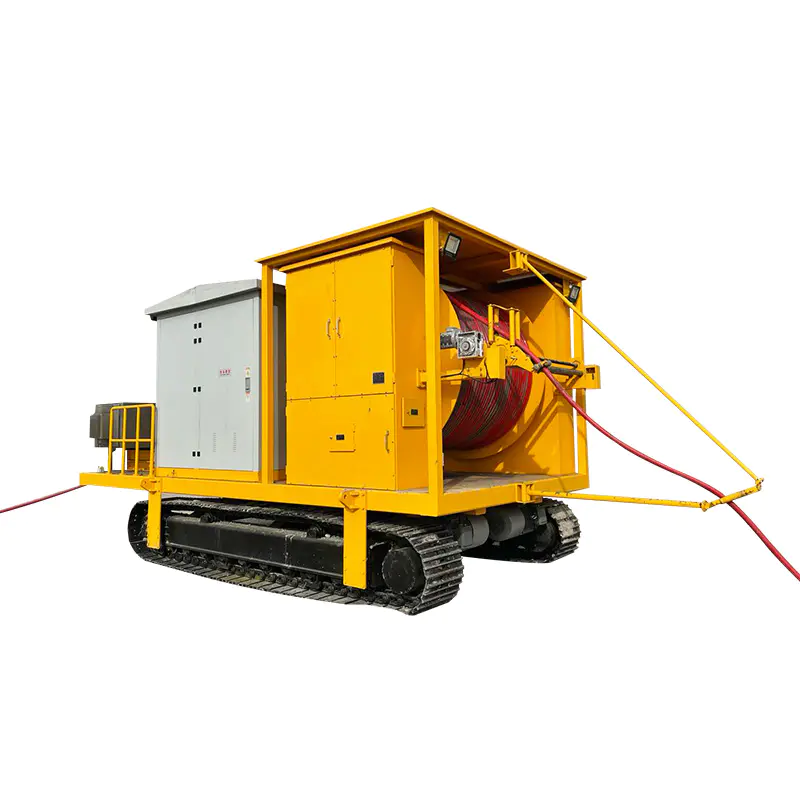
Drive Mechanisms: Drum Winch vs. Capstan vs. Bullwheel Puller
Three distinct mechanical configurations dominate the cable pulling winch category, each suited to different pulling distances, cable types, and job site conditions:
Drum Winch
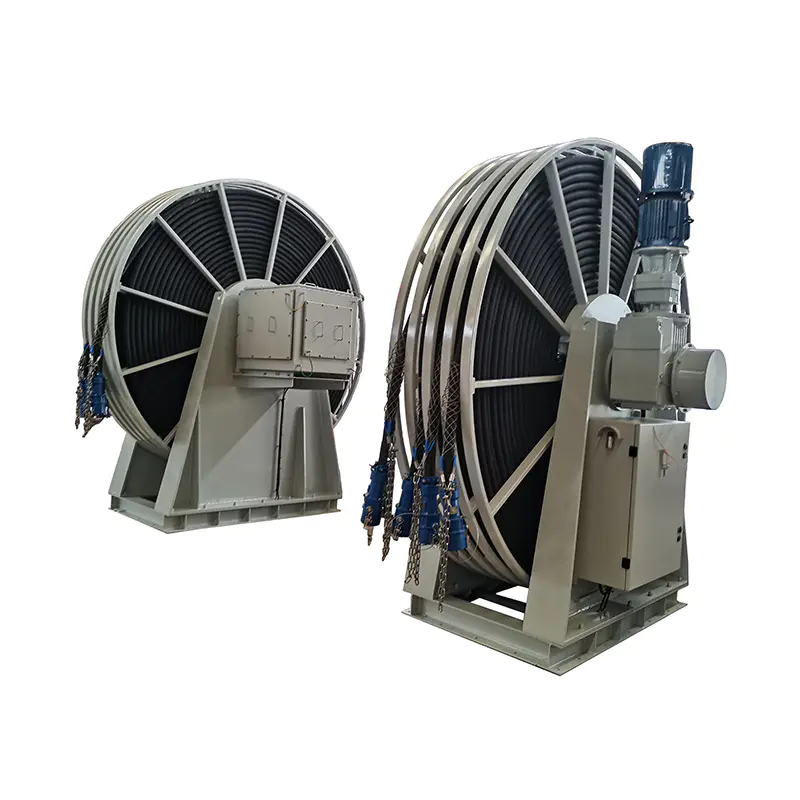
The drum winch spools the pulling rope or cable directly onto a rotating drum. As the drum turns, the rope winds in and the cable is pulled. This configuration is simple, compact, and well-suited to short-to-medium pulls where the total rope length required does not exceed the drum's storage capacity. The primary limitation is that tension varies slightly as rope layers build up on the drum — effective pulling radius increases with each wrap, changing the mechanical advantage unless the winch incorporates a level-wind mechanism and compensating controls. Drum winches are widely used in residential and light commercial electrical work, typically in capacities from 500 kg to 5,000 kg pulling force.
Capstan Winch
A capstan winch uses a rotating vertical or horizontal drum around which the pulling rope makes multiple wraps. The capstan does not store rope — it grips through friction, passing the rope through continuously. A separate take-up reel or manual coiling handles the outgoing rope. This configuration delivers constant tension regardless of how much rope has been pulled, making it appropriate for very long pulls where consistent force is critical. Capstan winches are common in telecommunications and utility cable installation where pulls of several hundred meters are routine.
Bullwheel Puller / Cable Tensioner
Bullwheel pullers use one or more large-diameter grooved wheels (bullwheels) through which the cable itself passes and is gripped directly — eliminating the pulling rope entirely. The cable feeds over the bullwheel, which applies traction via friction or mechanical gripping inserts matched to the cable's outer diameter and jacket material. This design is standard for overhead transmission line stringing and large underground cable installation where the cable diameter and weight make rope-based pulling impractical. Bullwheel pullers are typically the largest and most powerful category, with rated pulling forces from 20 kN to over 200 kN for transmission line work.
Power Sources and Drive Systems
Cable pulling winch machines are available across multiple power source configurations, and the choice directly affects where and how they can be deployed:
| Power Source | Typical Force Range | Key Advantage | Limitation |
|---|---|---|---|
| Electric (single/three-phase) | 500 kg – 10,000 kg | Clean, quiet, precise speed control | Requires power supply on site |
| Petrol / Diesel engine | 1,000 kg – 50,000 kg+ | Fully self-contained, high power | Emissions, noise, fuel logistics |
| Hydraulic (standalone pump) | 2,000 kg – 100,000 kg+ | Smooth force output, very high capacity | Requires separate hydraulic power unit |
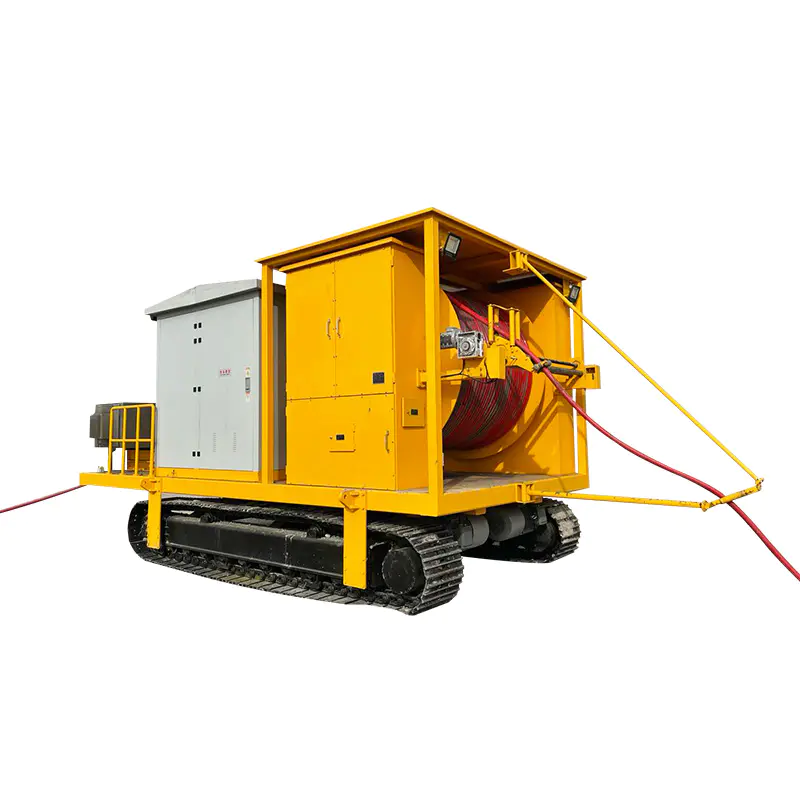
| Hydraulic (vehicle-mounted) | 5,000 kg – 200,000 kg+ | Maximum portability and power | High equipment cost, access constraints |
| Battery (cordless) | 200 kg – 2,000 kg | No power or fuel required on site | Limited runtime and pulling force |
For indoor commercial and industrial cable installation where grid power is available, electric drum winches with variable-speed drives are the preferred solution — they offer precise pulling speed control (typically 0–15 m/min adjustable), low noise suitable for occupied buildings, and integrated overload protection. For utility and infrastructure work in open terrain, diesel-hydraulic systems mounted on trailers or service vehicles provide the combination of high pulling force and site independence that electric units cannot match.
Key Technical Specifications to Evaluate
Selecting a cable pulling winch machine requires matching its specifications to the demands of the intended pull. The following parameters are the primary technical criteria:
Rated Pulling Force
The maximum sustained tension the winch can develop, expressed in kilonewtons (kN) or kilograms-force (kgf). This must exceed the calculated maximum pulling tension of the cable run, which depends on cable weight per meter, conduit length, number and radius of bends, and the coefficient of friction between cable jacket and conduit wall. A common industry formula estimates pulling tension as: T = W × L × f, where W is cable weight per unit length, L is conduit length, and f is the friction coefficient (typically 0.35–0.5 for lubricated PVC-jacketed cable in PVC conduit). A safety factor of 1.5–2.0 is applied to the calculated tension when selecting winch capacity.
Line Speed
Pulling speed affects both productivity and cable safety. Excessively fast pulling generates dynamic tension spikes and can cause cable jacket damage at conduit bends. Most cable installation standards recommend pulling speeds of 3–10 m/min for power cables; fiber optic cables require slower, more controlled speeds — often 3–5 m/min maximum — to prevent stress on the fibers. Variable-speed control, ideally infinitely adjustable rather than step-switched, is a meaningful feature for contractors pulling diverse cable types.
Rope Capacity and Diameter
Drum winches have defined rope storage capacity — typically expressed as rope diameter × total length (e.g., 10 mm × 100 m). The pulling rope must have a rated breaking strength at least 4–5 times the winch's maximum pulling force. Steel wire rope, polyester rope, and UHMWPE (Dyneema) pulling lines are all used; UHMWPE is increasingly preferred for its combination of high strength, low weight, and absence of stored elastic energy that makes steel rope dangerous when it snaps under tension.
Tension Monitoring and Overload Protection
Real-time tension monitoring is a critical feature that separates professional cable pulling equipment from basic winches. A load cell or hydraulic pressure sensor measures actual pulling tension continuously, displaying it on an analog gauge or digital readout visible to the operator. When tension approaches the cable's rated maximum pulling tension — which for power cables is typically calculated from conductor cross-section and is specified by the cable manufacturer — the operator can slow or stop before damage occurs. Automatic overload cutoff, which stops the winch when a preset tension limit is exceeded, eliminates reliance on operator reaction time and is required by many utility specifications.
Braking System
A fail-safe braking system holds the load when power is interrupted or the operator releases the control. Spring-applied, hydraulically released (SAHR) brakes are the standard for safety-critical applications — the brake is engaged by default and requires active hydraulic or electrical pressure to release, ensuring the load cannot run away during a power failure. Dynamic braking on electric winches provides smooth controlled deceleration without mechanical brake engagement during normal stopping.
Cable Sidewall Pressure and Bend Radius Limits
Winch pulling force must be managed with awareness of two cable-specific damage mechanisms that are distinct from simple tension overload:
Sidewall pressure occurs when a tensioned cable rounds a conduit bend. The cable presses against the outer wall of the bend with a force equal to the pulling tension divided by the bend radius. The allowable sidewall pressure varies by cable construction — typically 300–500 N/cm of conductor diameter for power cables, and as low as 50–100 N/cm for some armored telecommunication cables. Exceeding this limit crushes the cable insulation, deforms the conductor, or damages armor wires without any visible external indication until the cable fails in service.
Calculating sidewall pressure at each bend in a conduit run — and verifying that the winch's pulling tension at that point remains within limits — is an essential pre-pull engineering step. Some modern cable pulling winches incorporate software-assisted pull planning tools that calculate tension buildup and sidewall pressure at each bend based on entered conduit geometry and cable parameters.
Minimum bend radius is a separate constraint: even with low tension, bending a cable tighter than its rated minimum bend radius damages the insulation system through mechanical stress on the dielectric material. Minimum bend radius is specified as a multiple of the cable's overall diameter — typically 8–12× for armored power cables and 20× or more for certain fiber optic cables.
Accessories and Supporting Equipment
A cable pulling winch machine operates as part of a system. The following accessories are standard components of a professional cable pulling setup:
- Cable pulling grips (Kellems grips): Woven wire mesh socks that attach to the cable end and transfer pulling tension to the cable's outer jacket or armor rather than the conductors. Correctly sized grips are essential — an undersized grip slips; an oversized grip applies uneven stress. Grips are rated for specific cable outer diameter ranges and maximum pulling tension.
- Swivel connectors: Inserted between the pulling rope and the cable grip to prevent torque transfer. Without a swivel, rotation of the pulling rope under tension can twist the cable, potentially damaging conductors and shortening service life in twisted-pair or concentric-lay cables.
- Cable feeding rollers and guide sheaves: Positioned at conduit entry points and directional changes to support the cable and reduce friction as it enters the duct system. Roller diameter must be large enough to maintain cable bend radius above the minimum rated value.
- Cable lubricant: Applied to the cable jacket and conduit interior to reduce the friction coefficient from approximately 0.5 (dry) to 0.2–0.35 (lubricated). Lubricant selection must be compatible with the cable jacket material — polyethylene-jacketed cables require water-based lubricants; oil-based products can swell certain jacket materials.
- Pulling line (fish tape / mule tape): Pre-installed in conduit before the pull to connect the winch rope to the cable. Fiberglass fish tape suits short indoor runs; flat polyester mule tape with printed length markings is standard for longer underground duct pulls.
- Remote control pendant: Allows the operator to control winch speed, direction, and emergency stop from a position where the cable entry point is visible — essential for safety and cable condition monitoring during the pull.
Safety Standards and Operational Requirements
Cable pulling winch operations involve significant stored mechanical energy — a tensioned steel pulling rope or a heavy cable under load can cause severe injury if a fitting fails or the cable jams and suddenly releases. Formal safety protocols reduce this risk:
- Clear the pulling line: No personnel should stand in line with the rope or cable during a pull. A snapped rope or fitting carries the energy of a projectile along the axis of the pull. Safety barriers or established exclusion zones at both the winch end and the cable feeding end are standard practice.
- Communication protocol: The operator at the winch and the attendant at the cable reel or conduit entry must maintain continuous communication — typically via two-way radio on larger pulls. A clear stop signal understood by all crew members must be established before the pull begins.
- Equipment inspection: Pulling rope, grips, swivels, and sheaves should be inspected before each use for wear, kinking, corrosion, and deformation. A pulling grip that shows broken wire strands or a swivel with play in the bearing should be removed from service immediately.
- Rated load compliance: The winch must never be operated above its rated line pull. Load cells and overload cutoffs enforce this automatically; on equipment without automatic protection, the operator must monitor the tension gauge continuously and stop before the limit is reached.
- Anchoring and stability: The winch must be anchored securely to resist the full reaction force of its rated pull. Vehicle-mounted winches use the vehicle's mass and tie-down anchors; standalone units require ground anchors, deadman anchors, or structural attachment points rated to exceed the maximum pulling force.
Applicable standards include ASME B30.7 (base-mounted drum hoists), relevant IEC standards for electrical equipment used in cable installation, and utility-specific construction specifications that define maximum pulling tensions, inspection intervals, and operator qualification requirements for crews working on distribution and transmission infrastructure.