

 русский
Content
- 1 How to Choose a Cable Pulling Winch
- 2 What Size Cable Pulling Winch Do I Need?
- 3 How Much Pulling Force Is Needed for Cable Installation?
- 4 What Winch Is Best for Pulling Electrical Cable?
- 5 How to Calculate Cable Pulling Tension
- 6 Cable Pulling Winch for Underground Cable
- 7 Cable Pulling Winch for Long Distance Cable Installation
- 8 How to Pull Heavy Electrical Cable Safely
How to Choose a Cable Pulling Winch
A cable pulling winch is a motorized machine used to draw electrical, fiber optic, or communications cable through conduit, ductbank, cable tray, or underground raceway during installation. Choosing the right one comes down to matching the winch's pulling force, line speed, and control features to the specific characteristics of your cable, the length and path of the pull, and the site conditions you're working in.
The core decision framework generally works through four questions in sequence: how much force does this specific pull actually require, what line speed keeps the job efficient without risking cable damage, does the pull path call for underground-rated or portable equipment, and what safety and control features (tension monitoring, automatic shutoff) does the job's risk level justify. Each of these is covered in more detail below.
What Size Cable Pulling Winch Do I Need?
Winch "size" in this context really means rated pulling capacity, and it should always be selected with a safety margin above your calculated maximum pulling tension — not simply matched exactly to it. As a general guideline:
| Application | Typical Winch Capacity |
|---|---|
| Light commercial/residential conduit runs | 2,000-5,000 lbs |
| Medium industrial and commercial ductbank pulls | 5,000-15,000 lbs |
| Heavy underground/utility-scale cable installation | 15,000-40,000+ lbs |
A commonly used rule of thumb is to select a winch rated at least 20-25% above your calculated maximum pulling tension, giving margin for unexpected friction increases, minor path deviations from the design plan, or measurement error in your tension calculation.
How Much Pulling Force Is Needed for Cable Installation?
Required pulling force varies enormously based on several compounding factors, which is exactly why a generic answer isn't useful — the same cable can require dramatically different pulling force depending on the path it travels. The primary factors driving pulling force include:
- Cable weight per unit length — heavier cable (larger conductor size, more conductors, thicker insulation/armor) directly increases the base friction force along the entire pull length.
- Total pull length — friction accumulates continuously along the path, so longer runs require proportionally more force even with identical cable and conduit conditions.
- Number and severity of bends — each bend in the conduit path adds friction that compounds with the friction from straight sections, and tighter-radius bends add more resistance than gentle sweeps.
- Conduit material and condition — smooth PVC conduit generally offers lower friction than rougher or damaged conduit surfaces, and the coefficient of friction varies meaningfully between materials.
- Use of pulling lubricant — appropriate cable pulling lubricant can reduce friction significantly compared to a dry pull, directly lowering the required force.
What Winch Is Best for Pulling Electrical Cable?
There's no single "best" winch across every scenario, since the ideal machine depends heavily on the job's scale and setting — but a few equipment categories consistently perform well for specific electrical cable pulling situations:
- Hydraulic cable pulling winches — offer smooth, controllable pulling force and are common for medium-to-heavy industrial and utility applications where consistent tension control matters.
- Electric cable pulling winches — well suited to sites with reliable power access, offering precise speed control and often quieter operation than hydraulic or engine-driven alternatives.
- Engine-driven (gas/diesel) winches — practical for remote sites without power access, particularly for underground and long-distance utility installations far from a power source.
- Winches with integrated tension monitoring — increasingly the preferred choice for any cable pull where exceeding the cable's maximum rated pulling tension could cause damage, since real-time tension feedback lets operators react before damage occurs.
How to Calculate Cable Pulling Tension
Cable pulling tension calculations follow established engineering formulas that account for cable weight, friction coefficient, path geometry, and any elevation change along the route. While the full calculation for a complex multi-bend path involves segment-by-segment analysis, the basic building blocks are:
1
Calculate straight-section friction as the product of cable weight per unit length, pull length, and the coefficient of friction between the cable and conduit/duct surface.
2
Add tension at each bend using the capstan equation, which calculates how tension multiplies as cable wraps around a curved section based on the bend angle and friction coefficient.
3
Account for vertical sections separately, since pulling cable upward adds the cable's own weight directly to the tension calculation, while pulling downward can actually reduce required force (though it introduces its own control challenges).
4
Sum all segments along the full pull path to arrive at total estimated maximum tension, then compare that figure against both the cable manufacturer's maximum rated pulling tension and your winch's rated capacity.
Given the number of variables involved, most electrical contractors and utilities use cable pulling calculation software or published reference tables from cable and conduit manufacturers rather than performing these calculations manually for anything beyond simple, short, straight pulls.
Cable Pulling Winch for Underground Cable
Underground cable installation introduces specific challenges that above-ground or interior pulls don't face: longer typical run lengths between manholes or pull boxes, more bends and directional changes across the buried conduit path, and often limited access for repositioning equipment mid-pull. Winches selected for underground work generally need:
- Higher rated capacity to account for the greater cumulative friction across longer underground duct runs with multiple bends between access points.
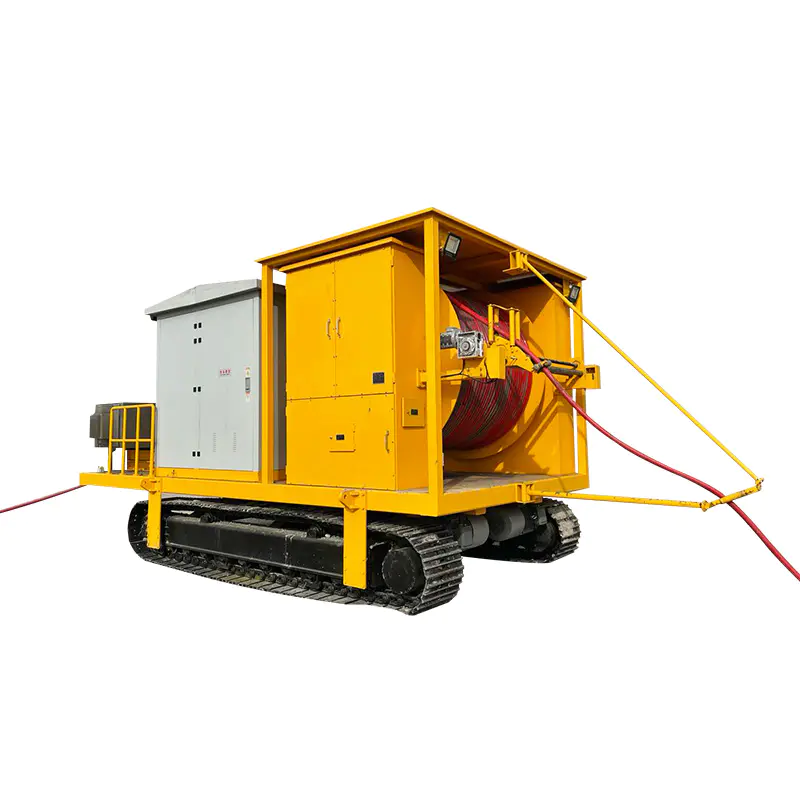
- Portable or trailer-mounted configurations that can be positioned at manholes, vaults, or pull boxes along the route, since underground installations often require repositioning equipment between multiple duct sections.
- Reliable tension monitoring, since operators often can't visually observe the cable's condition along a buried conduit run the way they could on an open cable tray installation.
Cable Pulling Winch for Long Distance Cable Installation
Long-distance cable pulls — common in utility transmission projects, large industrial campuses, and telecommunications infrastructure — compound the friction and tension challenges of a standard pull simply through sheer length. For these installations, a few additional considerations come into play beyond standard winch sizing:
- Intermediate pulling points — very long runs are often broken into multiple shorter pulls using intermediate manholes or vaults, rather than attempting a single continuous pull that would require an impractically large winch.
- Consistent lubrication application across the full run length, since friction reduction becomes increasingly important to overall required force as pull distance increases.
- Higher-capacity, higher-line-speed equipment — longer pulls benefit from winches that can maintain adequate pulling speed over an extended duration without overheating or requiring frequent operational pauses.
How to Pull Heavy Electrical Cable Safely
Cable pulling involves significant stored energy and mechanical force, and safety practices matter as much as equipment selection for a successful, incident-free installation:
- Never exceed the cable manufacturer's maximum rated pulling tension, even if the winch itself is capable of higher force — exceeding cable-rated tension risks internal conductor damage that may not be visible from the outside.
- Use in-line tension monitoring equipment whenever pulling tension is a meaningful risk factor, allowing operators to stop immediately if tension approaches unsafe levels.
- Keep personnel clear of the pull line's direct path, since a failed pulling rope or connection under high tension can release stored energy suddenly and dangerously.
- Inspect rigging, pulling eyes, and connections before each pull, since a failure at any connection point in the pulling chain — not just the winch itself — can cause the same safety hazard.
- Maintain clear communication between the winch operator and any personnel feeding cable at the opposite end, since coordinated stops are essential if an obstruction or unexpected tension spike occurs mid-pull.
Practical tip: When tension calculations and cable ratings are close to your winch's capacity, it's worth reassessing the pull plan — adding an intermediate pulling point or increasing lubrication — rather than proceeding with minimal safety margin.